Don’t miss anything! Sign up for my newsletter & join our Facebook community of 1,000+ like minded thinkers!
David's Sacrifice: A Blueprint for Corporate Wealth
Every leader eventually faces a version of the same moment: you're exhausted, pressured, trapped in circumstances you didn't fully choose, and something inside you wants relief. The question isn't whether you'll want it. The question is what you'll do when someone else pays the price for you to have it.
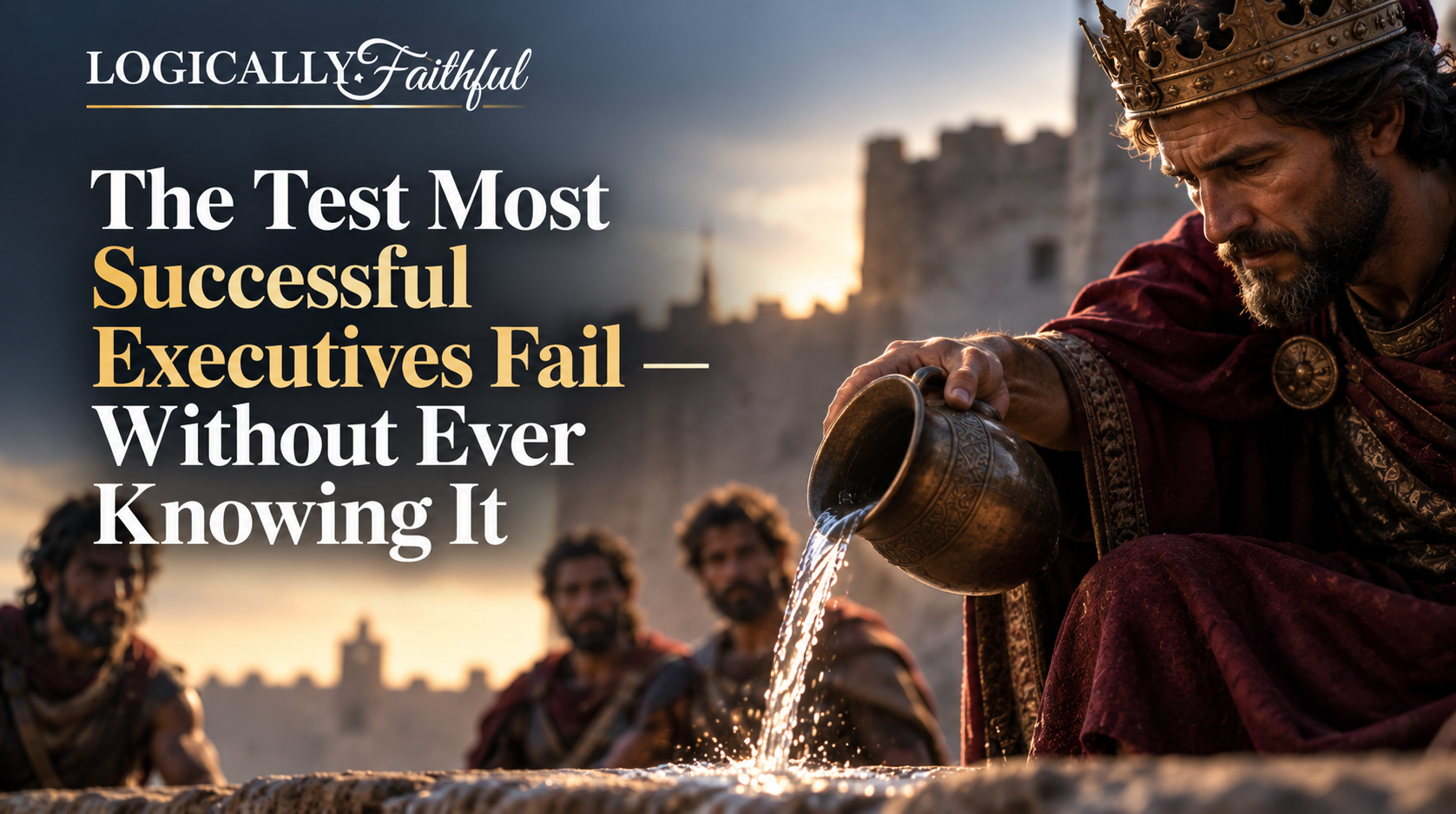
There's an old story that gets at this better than any leadership book I've read. King David was holed up in a stronghold near Bethlehem, hiding from enemy forces, worn down by the kind of pressure that makes men crave small comforts. Almost offhandedly, he said something like: I wish I had water from the well back home. He wasn't issuing an order. It was the kind of thing a tired man mutters to no one in particular.
Three of his best warriors heard it anyway. Without being asked, they broke through enemy lines, fought their way to that well, filled a skin with water, and fought their way back out. They nearly died for a cup of water their king hadn't even officially requested.
David took the water. Looked at it. And poured it out on the ground. He wouldn't drink it. He said it would be like drinking the blood of the men who risked their lives for it. He understood something most executives only learn after it's cost them everything: some things that are handed to you aren't actually meant for your consumption, because of what they cost someone else to get.
The boundary this draws for you
I work with executives and founders building real businesses, and almost every one of them eventually hits this fork. Revenue starts flowing. Growth gets real. And somewhere in there, a question quietly shows up: how much of this is mine to take, and at whose expense? Here's the line David drew, and it's the one I'd ask you to draw too.
Legitimate wealth fuels the mission. It reinvests in the people and the purpose. It strengthens what you're building without quietly cannibalizing it. Illegitimate wealth is extracted. It's the bonus pulled from a team that's burning out, the margin padded by underpaying people who can't push back, the "I earned this" that's actually "someone else absorbed the cost of this."
David had every justification available to a king. He was thirsty, he was under siege, and good men chose freely to get him that water. Nobody would have blinked if he drank it. He poured it out anyway, because he refused to let his comfort be the thing other people bled for.
Why this matters more than it looks like it does
Here's the warning, and I don't say this lightly: unchecked appetite doesn't announce itself. It doesn't show up as obvious greed. It shows up as a slow redefinition of what you deserve, a growing comfort with not looking too closely, a fortress mentality where you insulate yourself from the real conditions of the people building your success. And it always ends the same way. Not usually with a dramatic scandal, more often with a quiet rot. Culture fractures. Trust erodes. The thing you spent a decade building becomes brittle right when you need it to hold.
The painful price is the one you pay upfront: restraint when you don't have to show it, accountability when no one's checking, saying no to the water when you could easily drink it and no one would call you out. That price is cheaper than the one you pay later.
Four questions to run before your next decision
David's test wasn't whether he could get the water. It was whether he could resist it once he had it in his hands. Yours will show up smaller and more boring, in a payroll decision, a vendor negotiation, a bonus structure, a choice about who absorbs the risk when the quarter gets tight. Here's how to catch it before it catches you.
1. Who bled for this? Before you take a payout, bonus, or margin, name the specific people whose labor, risk, or underpayment funded it. If you can't name them, that's a flag, not a clearance.
2. Would I still take it if they were standing in the room? David poured the water out in front of the men who risked their lives for it. Decisions made in private that couldn't survive that room usually shouldn't survive at all.
3. Am I calling necessary restraint "leaving money on the table"? Greed rarely announces itself as greed. It shows up dressed as smart business. Check which one you're actually practicing.
4. What would it cost me to pour this one out? Not rhetorically, actually price it. If the honest answer is "more than I'm willing to pay," you've found your blind spot.
This is precisely the kind of audit I run with executives one on one, not as abstract ethics, but against your actual P&L, your actual team, your actual decisions this quarter. If you're sitting with a version of this tension right now and want help seeing it clearly, that conversation is one email away.