Don’t miss anything! Sign up for my newsletter & join our Facebook community of 1,000+ like minded thinkers!
3 Reasons Why Science is Not What You Think It Is: Beyond the Myth of Scientism
“If you cannot prove it scientifically, then I cannot believe it.” This is a claim made by many students and individuals who have swallowed the lie of secularism and scientism. The myth suggests that only what we can prove with the hard sciences—physics, chemistry, biology—can be considered true or rational. On this view, anything else is relegated to the realm of "blind faith" or "private opinion".

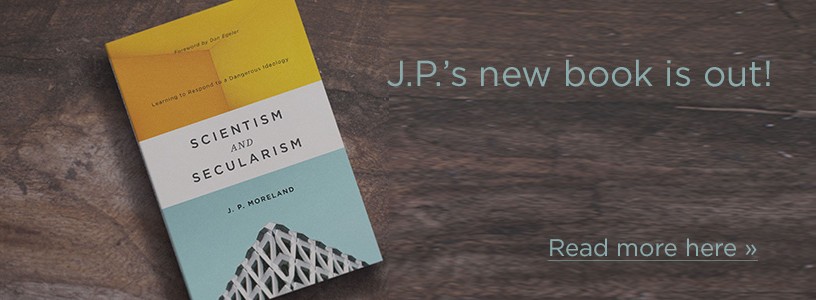
In this episode of Logically Faithful, I have the honor of interviewing one of my heroes and mentors, Dr. J.P. Moreland. J.P. is a Distinguished Professor of Philosophy at the Talbot School of Theology and holds degrees in chemistry, theology, and philosophy. In his recent work, Scientism and Secularism, he demolishes the ideology that is currently hollowing out our cultural understanding of truth.
J.P. defines Scientism as “the view that the hard sciences provide the only genuine knowledge of reality”. Under this shadow, claims about the spiritual world, God, or even love lose all intellectual authority.
But as we discuss in this interview, science itself rests on a foundation it cannot prove.
Prefer Listening?
Listen to the full podcast episode below for a deeper exploration.
Key Ideas in Brief
- Scientism is self-refuting: The statement "only scientific truths are valid" is a philosophical statement, not a scientific one, meaning it fails its own test.
- Science has limits: Fields like mathematics, logic, and ethics provide "necessary truths" that science assumes but cannot justify.
- Consciousness is non-physical: Science can map the brain, but it cannot explain the internal experience of "what it is like" to be you.
- Knowledge is not certainty: You can truly know something to be true without having 100% absolute certainty; knowledge is about having sufficient evidence.
- Philosophy is the "First Philosophy": Science depends on philosophical assumptions (like the reliability of our senses) that must be true before science can even begin.
The Defining Conflict: Strong vs. Weak Scientism
Before diving into the arguments, it is essential to understand exactly what we are fighting. J.P. distinguishes between two versions of this ideology. Strong Scientism is the radical claim that something is true only if it is a scientific claim that has been successfully tested. If it’s not in a textbook or a lab report, it’s not knowledge.
Weak Scientism is more subtle and more pervasive. It allows for the existence of other fields like art or religion, but it insists that science is vastly superior to them. In this view, if a scientific theory conflicts with a theological or moral claim, the scientific theory always wins by default because it is "knowledge" while the others are just "belief".
Reason 1: Scientism is Logically Self-Refuting
The most glaring problem with scientism is that it cannot survive its own scrutiny. The statement "only scientific truths are the only kind of truth" is not itself a scientific truth. You cannot go into a laboratory and perform an experiment to prove that "only science gives us knowledge."
That statement is a philosophical claim about science. Therefore, if the statement is true, it is a non-scientific truth. But if it is a non-scientific truth, then the statement itself proves that there are truths outside of science—which means the statement is false. It is like saying, "I cannot speak a word of English." By the very act of speaking, you refute the claim.
Reason 2: The Domain of Necessary Truths
There are many areas of reality that we know with greater certainty than scientific theories, yet we cannot prove them with science alone. These include:
- Logic and Mathematics: These are a priori and necessary truths. Science doesn't prove that 2+2=4; it assumes it in order to do its work.
- Moral Knowledge: Science is excellent at describing what is (the descriptive), but it is powerless to tell us what ought to be (the normative). A scientist can tell you the chemical composition of a poison, but science cannot tell you that it is "wrong" to use that poison to kill an innocent person.
- The Reliability of the Senses: Science assumes that our eyes, ears, and brains accurately report the external world. But you cannot use science to prove your senses are reliable, because you would have to use your senses to conduct the very experiments intended to prove them.
Reason 3: The Mystery of Consciousness and Physical Laws
J.P. Moreland is well-known for his defense of the soul and the non-physical nature of the mind. He argues that our most intimate thoughts and experiences—what philosophers call "qualia"—are not physical.
If a scientist knew everything there was to know about the brain of a bat—every neuron, every chemical signal—they still would not know "what it is like" to be a bat. Physical facts are public and accessible, but mental facts are private and internal. This "knowledge gap" destabilizes the base of scientism. If science cannot account for the very consciousness that is doing the science, it cannot be an exhaustive map of reality.
Furthermore, the very laws of physics that allowed our universe to come into existence are not physical objects themselves. You cannot trip over the law of gravity or put the laws of thermodynamics in a test tube. They are the invisible, rational templates upon which the physical world is built.
Knowledge vs. Certainty
One of the most liberating points J.P. makes in the interview is that knowledge does not require 100% absolute, mathematical certainty. We often feel that if we have a "shadow of doubt," we don't really know our faith is true. But as J.P. points out, knowledge is "defeasible"—meaning we can know something while still being open to the fact that we might be mistaken.
By reclaiming the idea that theology and ethics are "knowledge-based" fields, we provide ourselves with a ground of stability and courage. We believe not because it brings us comfort (though it does), but because it is actually, logically, and demonstrably true.
Exploring These Questions Personally
Some questions about faith and doubt cannot be resolved by arguments alone. They are lived, wrestled with, and experienced over time.
If you’d like thoughtful, non-judgmental ways to explore these questions more deeply, here are a few options:
Continue the Conversation
Wrestling with questions about God, faith, and meaning?
Join the newsletter for thoughtful reflections on belief, doubt, philosophy, and the search for truth, plus practical insights to live wisely, and believe courageously.
You Might Like These
Reason, God And The Meaning Of Life: Dr. Chris Firestone,PhD
Explore the limits of reason in Kant’s philosophy & what they mean for God, morality, and meaning of life in this conversation with philosopher Chris Firestone.
Unity of Truth and the Plurality of Faiths
Do all religions worship the same God? This lecture explores religious pluralism, universalism, and unity of truth through a philosophy of religion perspective.
Hell, the Soul, and Evil with Richard Swinburne
The philosophy of hell and the soul explored with Richard Swinburne — and how these ideas shape Christian philosophy of the afterlife and human nature.