Don’t miss anything! Sign up for my newsletter & join our Facebook community of 1,000+ like minded thinkers!
- Home
- Spiritual Direction
- How to Interpret the Bible
How to Interpret the Bible: 10 Simple Rules to Get the Most Out of Your Bible Study
By Dr. Khaldoun A. Sweis · Originally published November 2016
- "How can you Christians pick and choose what you want from the Bible? How can you know what the Bible says from what you want it to say? In this post I will share 10 simple ways to interpret the Bible that are not simplistic.
Hermeneutics : The art and science of how to interpret the Bible without subjecting it to your own sociological opinions and biases.
The Bible is a human book, it was written by men for men. The copies we have of it have errors in them (which are greatly exaggerated by the way!) But the Bible in the original documents, is God-breathed, that meand that it also a divine product. It is without any errors (facts about which it speaks, whether scientific, architecture, or even cosmology) because a perfect God inspired the men who wrote the original books in it.Interested in a discussion on inerrancy? See this post.John Quincy Adams wrote :
Now how can we understand this book? Can we know what the originals said? We can responsibly come to see what these original manuscripts have said through the science of Textual Criticism."So great is my veneration for the BIBLE that the earlier my children begin to read it, the more confident will be my hope that they will prove useful citizens to their country and respectable members of society...I have made it a practice for several years to read the BIBLE through in the course of every year ( five chapters every morning) . . ."
But we have a small problem! We don't have any of the original bible books.
Bart Ehrman's book Misquoting Jesus (Harper Collins 2005) says it this way about the New Testament text:What good is it to say that the autographs (i.e., the originals) were inspired? We don't have the originals! We have only error-ridden copies, and the vast majority of these are centuries removed from the originals and different from them . . . in thousands of ways.Although there is truth to this. It is incomplete truth. Textual Criticism examines the existing manuscript witnesses to the New Testament in order to produce a text that is as close as possible to the original. The New Testament has been preserved in more manuscripts than any other ancient work, having over 5,300 Greek manuscripts dating from the 3rd century to the 16th century. The task of the textual critic, therefore, is to sort through the variants and establish a "critical text" that is intended to represent the original by best explaining the state of all extant witnesses. See this article for more information. The central message of the bible is Him. It is about Jesus and the kingdom of God. Jesus functions as the theological center of biblical theology. Jesus is the goal, the point, and the significance of every text. He is God and He is the gospel from the first garden of Eden to the Garden of Gethsemane to the Garden of the Tree of Life in Revelation 21-22. Now, with all that said lets get to Hermeneutics ! Wayne Grudem in his work Systematic Theology, writes this.
In order to help people to avoid making mistakes in interpreting Scripture, many Bible teachers have developed “principles of interpretation,” or guidelines to encourage growth in the skill of proper interpretation. The word hermeneutics (from the Greek word ἑρμηνεύω “to interpret”) is the more technical term for this field of study: hermeneutics is the study of correct methods of interpretation (especially interpretation of Scripture).
The Bible has always outlived its pallbearers. Voltaire in the 17th century said that Bible would be dead and gone in 100 years. His house now belongs to the French Bible Society.The Bible is not just one single book – it’s a diverse collection of 66 thoroughly harmonious books with one single theme that contains a broad variety of genres: historical, narrative, epic, law, poetry, prophecy, wisdom, gospel, apocalyptic and letters. Many Christians are not aware of this fact, let alone non-believers, written by 40 different authors. (shepherds, fishermen, doctors, kings, prophets, tax collectors and scholars). Most of these authors never knew one another personally. It was written over 1500 years and in 3 different ancient languages – Hebrew, Greek, and Aramaic on 3 different continents: Africa, Asia, and Europe. See for more. Now before you can honestly get into these you need to have a new heart that loves God. And that cannot happen unless you are changed within. See this link to see how. So keeping this in mind, lets begin! Below are some principles I have learned in my education and personal study on interpreting the Bible.
10 rules to get you started on interpretation the Bible
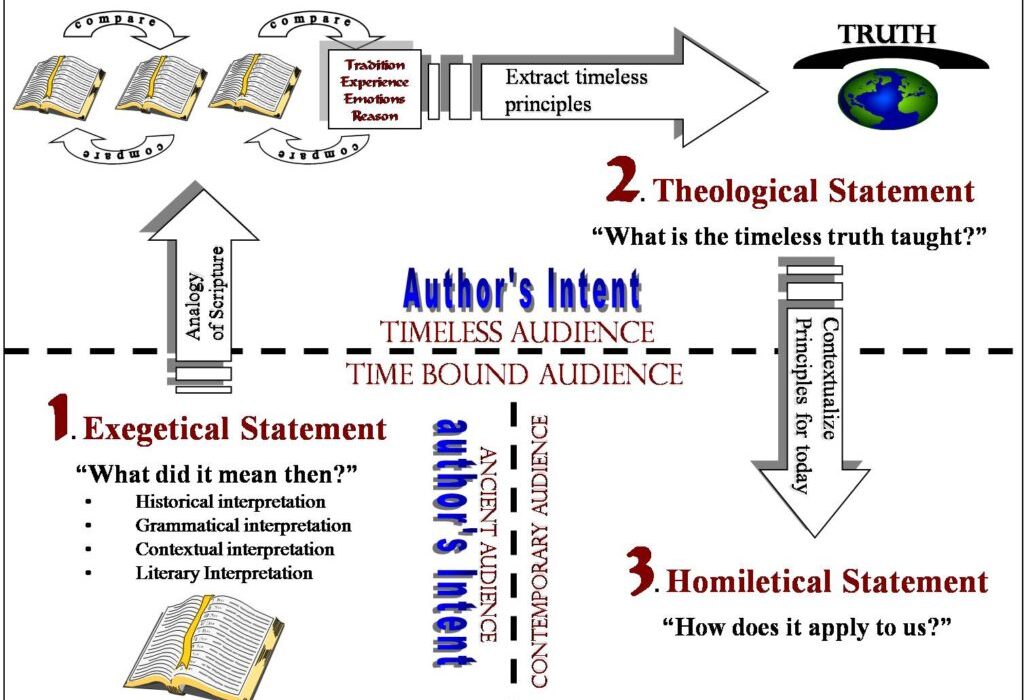
The first question to ask when reading a passage from the Bible is, "who is the author?" Is the author a king or a fisherman? Is his audience priests or Greeks? Some might concluded that all the promise of God to some particular person are to them. No. God told David that the sword shall not leave his house ... does that mean my house too?--Of course not. Or should we claim all commands in all scriptures to all believers? What about the sacrifice of Abraham’s the first born!? Certain commands are for certain people and others are for all people. Like the words of Jesus to the rich young ruler to sell every thing he owned. That was a specific command to a specific person. But the command, "love your enemies" was to all Christians in all places.1. Who is the author? Who is he writing to?
We must stop asking what does this mean to me, rather first we must ask what did it mean to the author. Some authors come right out and tell us why they wrote such as in Luke 1:1-4, Acts 1:1. But with others you have to read between the lines. When you outline a book you can see why it was written. No man has a right to say, as some are in the habit of saying “The Spirit tells me that such and such is the meaning of a passage, thus I never need to check the original meaning of the words.” How can you be sure it is not Satan, or your own preconceived notions that are deluding you if you will not check scripture to verify what you “feel?”2. What was the reason or the intention that the author, not what I want it to mean, wrote that particular book?
I personally know a lady who, going against all the caution of her family and friends said "God told me to marry him" and he turned out to be a drunk and terrible father who destroyed his family.
What is happening around his state, country when he is writing this? What is the context of his work? Is he in jail, in a palace? It makes a difference. In the book of Laminations, is the author depressed or is he grieving for his nation about to be brought under slavery? Is the Song of So Good will toward men. ngs a book about sexually or God’s love for his bride the church? Could it be both? What are the Customs of the people of the author's day and how do they relate to his writing? When Paul wrote about the armor of God (Eph 6:10-18) what was he referring to? What armor? If we study the roman military dress in Paul’s day, we will have a better understanding of what he was talking about. Why did Christ use wine as his gift to us to remember him by? If we study the customs we will see that it is a marriage proposal!3.What is the historical/cultural milieu in which the writer speaks?
Which one is the author giving to us. Abraham getting another woman to bear his children…is that OK for me because he did it? What about concubines that David and Solomon had? Should we have them too? Context and the difference between a prescriptive and a descriptive command make all the difference! It will make a difference to your wife too. :) A prescriptive command is one that is prescribed, that is we are to obey it today. "Do not commit adultery", is an example. But a descriptive command is just that, a description of what happened. But when Sarah gave her husband Abraham her slave to sleep with her, that was a descriptive truth, not a prescription for us today. See Genesis 16:1-16;21:1-21). Sadly the novel and movie The Handmaid's Tale (1990) and many abuses of Scripture take many descriptions in the Bible and make them prescriptions for today. Another example is artifacts. Many Christians site Bible passages of people worshiping or using relics (Mt 14:35-36; cf. Mk 6:56; Lk 8:43-44) as items of power or grace, therefore we should too. Again this is confusing what is described in the Bible with what is prescribed. The Bible never prescribes us to use these relics. Some great books to help in interpreting the Bible are4. Prescriptive vs Descriptive Truth
The most important one! If we were to read Matthew 27:5, (Judas went and hung himself) and Luke 10:37 (Go and do thou likewise) and John 13:27 (what you do, do it quickly). We would all be dead. We laugh, but some Christians live their lives by reading scriptures out of context. Be careful of this. It is the standard way to read any book, especially the Holy Bible. Immanuel Kant, German idealist philosopher, 1724-1804 wrote:5. What is the Context of the Scripture?
6. Identify the Literary genre. Is it poetry like most of the Psalms or is it historical like the books of the Kings? Is it a proverb? A psalm? A historical account? A vision? A dream? A prophecy? Is it a Similes, metaphors, and proverbs: look for the main point. Parables: Identify the focal teaching and main point. What is the historical/cultural significance of it? Now read Psalm 139: 20-22) which talk about hate of enemies. Read Matthew 5:43-48 which commands Love of enemies. With out the literary method you will confuse these!.“I believe that the existence of the Bible is the greatest benefit to the human race. Any attempt to belittle it, I believe, is a crime against humanity.”
Identify the multiple meanings of a word possessed in its time and culture. A word like “Lie” means two different things. It possible for the author to have two meanings, but it is not possible for him to have two opposite meanings. “Solomon Loved many women,” “Love the Lord your God?” Is this the same Hebrew word for Love? Or just because you do know the meaning of the words, you still have to look at the context as words change meaning in context! Example: "The Bears can crush the Cubs." This is meaningless without a US sports background. And even then they are different teams from different games not animals as the words originally meat. Do a correlation with other scriptures to see a theological systemic biblical understanding of the passage.7. Look up what individual words mean, again, in context.
And they don't need to be alive either :) Augustine, Aquinas, Luther, etc. Look up their commentaries. (Well...They may be more alive now than we are!) Study theology. But why? See this link.and this one too from Desiring God. President George Washington, First President of the United States wrote:8. Compare your work with others much more holy and wiser then yourself.
“It is impossible to rightly govern the world without God and Bible.”
9. When is a text cultural? When is it Transcultural?
A) Is it rooted in God’s unchanging nature, his Absolute laws, created order, his love etc.? B)Is it rooted in a cultural thing like bowing the head to an elder as opposed to just getting up when they enter the room etc. C) A good example of a trans-cultural issue is the the love relationship of husband and wife in Ephesians chapter 5. The respect and the love commands are based on our trans-cultural nature in Christ and his people (the Church). While the command to greet each other with a kiss (Rom. 16:16, I Corinthians 16:20, 2 Cor. 16 :12, 1 Thes. 5:26) is a cultural event because it is not based on an eternal truth, although the principle to greet each other is. D) If it is trans-cultural then do what you can to apply it to your culture now?A Text is literal if it was an eye witness account. Example: The Red Sea parting, The living, breathing Jesus talking with his disciples after he died. There is so much more to this than what I have written. A text is not to be necessarily literal if: 1) If the object in question is by nature invisible, like the creatures of revelations etc. 2) If the author claims to have "seen" it only with the inner eye in a vision or dream. 3) If the author "made it up"; it is fiction, like a parable. There is a lot of talk among scholars on Genesis for example. Is the creation story literal or poetic? Could it be a combination of both?10. When is a text to be taken literally ?
In all, I strongly recommend you do not do this alone, but in a community of believers in what has been know for 2000 years as the church. Not just any church, but a Church that actually takes the Bible seriously. Look up a local church that is sound, compassionate and uncompromising on the eternal truths in the Bible. But again, first you need to be in a relationship with the Maker, where he becomes more like a Father than a Creator. After that is complete, then you can read the bible as more than another book.
Abraham Lincoln, 16th President of the United States, 1809-1865“I am busily engaged in the study of the Bible. I believe it is God’s word because it finds me where I am.”
“I believe the Bible is the best gift God has ever given to man. All the good of the Savior of the world is communicated to us through the Book.”
What do you think?
From Theopedia below are some remarkable resources:
- Gordon D. Fee and Douglas Stuart, How to Read the Bible for All It's Worth, 3rd rev. edition. Zondervan, 2003. ISBN 0310246040
- Gordon D. Fee and Douglas Stuart, How to Read the Bible Book by Book. Zondervan, 2002. ISBN 0310211182
- Jeannine K. Brown, Scripture as Communication: Introducing Biblical Hermeneutics. Baker Academic, 2007. ISBN 0801027888
- Henry A. Virkler, Hermeneutics: Principles and Processes of Biblical Interpretation. Baker, 1981; reprint Baker Academic, 2007. ISBN 0801020670
- D. A. Carson, Exegetical Fallacies, 2nd ed., Baker Academic, 1996. ISBN 0801020867
- Grant Osborne, The Hermeneutical Spiral: A Comprehensive Introduction to Biblical Interpretation, revised and expanded, IVP Academic, 2006. ISBN 0830828265
- William Klein, et al., Introduction To Biblical Interpretation,revised and updated, Thomas Nelson, 2004. ISBN 0785252258
- Peter Cotterell, Linguistics and Biblical Interpretation. IVP, 1989. ISBN 0830817514
- Walter Kaiser and Moisés Silva, An Introduction to Biblical Hermeneutics: The Search for Meaning, revised and expanded, Zondervan, 2007. ISBN 0310279518
Dictionaries
- Kevin Vanhoozer, ed., Dictionary for Theological Interpretation of the Bible. Baker Academic, 2005. ISBN 0801026946
- Donald McKim, ed., Dictionary of Major Biblical Interpreters. IVP Academic, 2007. ISBN 083082927X
External links
- Must I Learn How to Interpret the Bible?, by D.A. Carson
- Hermeneutics and Christ, by Graeme Goldsworthy
- Chicago Statement on Biblical Hermeneutics, with commentary by Norman Geisler
- The Holy Spirit and Hermeneutics, by Daniel Wallace
- Issues in Hermeneutics, by Herman C. Hanko
- Hermeneutics & Biblical Theology, by S.M. Baugh
- Redrawing the Line between Hermeneutics and Application (PDF), by Brain A. Shealy
- General Revelation and Biblical Hermeneutics (PDF), by Robert L. Thomas
- How to Respond to "That's Your Interpretation", by R.C. Sproul
- The Presence of God Qualifying Our Notions of Grammatical-Historical Interpretation: Genesis 3:15 as a Test Case, by Vern Poythress
- Shared Intentions? Reflections on Inspiration and Interpretation in Light of Scripture's Dual Authorship, by Jared M. Compton
Hope this helps and does not muddle the issue even more so?!!
Want to go deeper? Read How to Know God Personally: The Christian Message in Plain Language, and if you are wrestling with these questions, I would be glad to talk. Schedule a free 15 minute conversation.
You Might Like These
Stop Seeking Happiness: Finding the True Purpose of Life
Stop chasing happiness and discover the true purpose of life. Find lasting meaning through duty and honor within the deep Christian meaning of life.
What To Do With My Life? Finding Spiritual Direction
Stuck asking "I don't know what to do with my life"? Discover 5 keys to finding spiritual direction, overcoming failure, and Christian spiritual formation.
4 Unexpected Ways to Address Marriage Problems
Facing marriage problems? Get Christian marriage advice on Biblical submission and 4 ways to address a suffering marriage.