Don’t miss anything! Sign up for my newsletter & join our Facebook community of 1,000+ like minded thinkers!
- Home
- Spiritual Direction
- Is It Possible to Know God?
Is It Possible to Know God? An Honest Look at the Christian Message
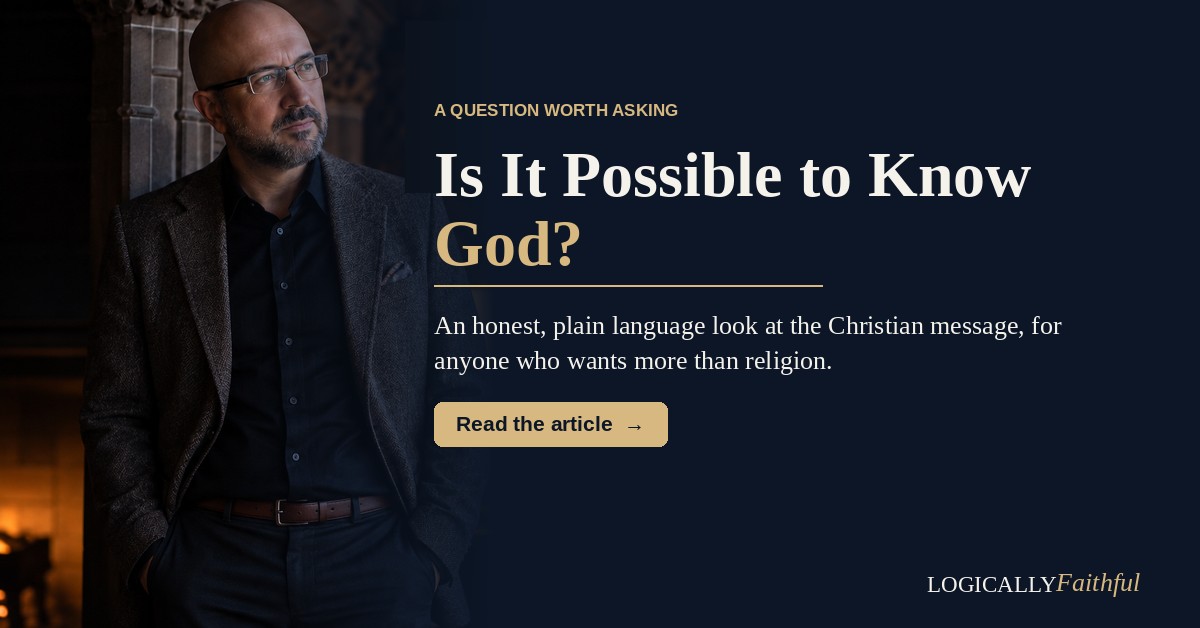
By Dr. Khaldoun A. Sweis
In the church where I was baptized in Jordan, we hold to an Arabic Trinitarian prayer that sounds like a quiet act of defiance: Bismi l-Ābi wa l-Ibni wa r-Rūḥi l-Qudus, al-Ilāhu l-Wāḥid. In the name of the Father, and the Son, and the Holy Spirit, one God.
That last phrase is there on purpose. Surrounded by neighbors who were told Christians worship three gods, we wanted to say plainly: we worship one God, and we have met Him in a face. The face of Jesus.
This article is for the person who is tired of religion as a set of rules, tired of spirituality as a mood, and wants to actually know God. Not know about Him. Know Him. If you came here from my article on what to do with your life, this is the deeper answer underneath that one. Direction starts with a relationship.
The Problem Is Not That You Lack Information
Most people think the distance between them and God is an information gap. If I just read one more book, hear one more podcast, win one more argument, then I will feel close to Him.
I am a philosopher. I love arguments. I have spent decades on the evidence for God and the historical case for the resurrection. But here is what the evidence eventually led me to see: the gap is not in my head. It is in my heart.
Think of a man who owns the finest map of Chicago ever printed. Every street, every alley, every building. He can tell you exactly where his father lives. But he has not spoken to his father in twenty years. The map is accurate. The map is useless. What he needs is not more cartography. He needs to knock on the door.
Christianity is not the map. It is the claim that the Father came out of the house, walked the length of the street, and knocked on our door.
The Roman Road: Five Stops on the Way Home
For generations, Christians have explained this message using a handful of verses from Paul's letter to the Romans. People call it the Roman Road. It is simple enough for a child and deep enough to drown a theologian. Here are the stops.
1. Something is broken, and it is not just "out there."
"For all have sinned and fall short of the glory of God." (Romans 3:23)
Sin is not a word for breaking a few religious rules. It is a word for a life turned in on itself. We were made to orbit God the way the earth orbits the sun, and we each decided to be our own sun. The result is what you would expect from a planet that leaves its orbit: cold, darkness, and collision.
Notice the word all. Not the criminals. Not the other political party. All. The line between good and evil does not run between groups of people. It runs straight through every human heart, mine included.
2. Brokenness has a cost.
"For the wages of sin is death, but the free gift of God is eternal life in Christ Jesus our Lord." (Romans 6:23)
Unplug a lamp and it does not get punished with darkness. Darkness is simply what happens when it is cut off from its source of light. Death, in the Bible's sense, is what happens to a soul cut off from the Source of life. It is not God being petty. It is reality being real.
But read the verse to the end. Wages are earned. Gifts are not. That one word, gift, is the hinge on which the whole door swings.
3. God did not wait for us to clean up.
"But God shows his love for us in that while we were still sinners, Christ died for us." (Romans 5:8)
Every other path I have studied says, in some form: climb the mountain and you might reach God. Christianity says: you will never reach the summit, so God came down the mountain to carry you.
Imagine a firefighter who walks into a burning building for a man who set the fire himself. That is not a reward for good behavior. That is love that refuses to wait for us to deserve it. On the cross, Jesus took the full weight of our brokenness, and three days later He walked out of the grave to prove the debt was paid and death had lost.
4. The gift must be received.
"If you confess with your mouth that Jesus is Lord and believe in your heart that God raised him from the dead, you will be saved." (Romans 10:9)
A rescue rope does no good if you will not grab it. Faith is not a leap into the dark. It is a step into the light, trusting the One who has shown Himself trustworthy. (I wrote more about this in Is Faith Blind?)
And notice what you confess: Jesus is Lord. Not Jesus is a good teacher, a helpful life coach, or one option on the spiritual buffet. Lord. The One with the right to run your life, because He gave His to save it.
5. The result is peace, not probation.
"Therefore, since we have been justified by faith, we have peace with God through our Lord Jesus Christ." (Romans 5:1) "There is therefore now no condemnation for those who are in Christ Jesus." (Romans 8:1)
Peace with God is not a feeling you have to keep manufacturing. It is a fact about where you stand. A child who has been adopted does not wake up each morning wondering if he is still in the family. He wakes up and walks into the kitchen like he belongs there, because he does.
Three Great Traditions, One Christ
People sometimes tell me, "But Christians cannot even agree among themselves." That is true, and I will not pretend otherwise. Reformed Protestants, Eastern Orthodox, and Roman Catholics have argued for centuries about how salvation is received and lived. Those disagreements matter. But stand back far enough and you see something remarkable: all three confess the same Nicene Creed, the same Triune God, the same crucified and risen Lord. They are describing one mountain from three sides.
The Reformed emphasis: a verdict in a courtroom
Reformed teachers press hard on Romans 3 through 5. You stand guilty before a holy Judge. You cannot pay. Christ pays it all, and God declares you righteous, not because of your record, but because of His. Grace alone, through faith alone, in Christ alone. This tradition will not let you soften sin, and so it will not let you cheapen grace. If you have ever felt crushed by your own failures, this is medicine.
The Orthodox emphasis: healing in a hospital
The Eastern Church tends to describe sin less as a crime and more as a disease, and the Church as a hospital for the soul. Christ is the Physician who took on our very nature in order to heal it from the inside. Saint Athanasius put it in a line that still makes people catch their breath: God became man so that man might become partaker of the divine life (see 2 Peter 1:4). Salvation is not only being forgiven. It is being made whole, slowly transformed into the likeness of Christ.
The Catholic emphasis: a family at a table
Catholic teaching stresses that grace is not a one time transaction but a life we are brought into: through baptism, nourished at the Lord's table, worked out in a faith that expresses itself through love (Galatians 5:6). You do not earn your way into the family. But once in, you are meant to grow up in it.
A courtroom, a hospital, a family table. Here is the honest truth: the New Testament uses all three pictures. Guilt needs a verdict. Sickness needs a cure. Orphans need a home. Jesus is all three: the Judge who takes the sentence, the Physician who heals the wound, and the Father's Son who brings us to the table.
Where these traditions disagree, I do not ask you to settle it on day one. A man drowning does not first need a lecture on the engineering of the boat. He needs to grab the hand reaching for him. The theology will follow, and it is worth studying deeply in a real church community, under real spiritual leadership. Faith in Christ was never meant to be "just you and Jesus."
"But Isn't It Arrogant to Say Jesus Is the Only Way?"
This is the question I get most, especially from thoughtful, educated people. I understand it. It sounds narrow.
But consider: every claim about ultimate reality excludes something. The person who says "all religions lead to the same place" is excluding every religion that says they do not, which is nearly all of them. Truth, by its nature, is exclusive. If it is true that Chicago is in Illinois, it is false that it is in Ohio, no matter how sincerely someone believes otherwise.
The real question is not whether Christianity is exclusive. It is whether it is true. And here Jesus puts the issue on the table Himself: "I am the way, and the truth, and the life. No one comes to the Father except through me" (John 14:6). C. S. Lewis famously pointed out that a man who said the things Jesus said would not be merely a great moral teacher. He would either be deluded, or a deceiver, or exactly who He claimed to be. The one option He does not leave open is the polite one.
Notice something else. Christianity is the only path where the exclusivity is generous. The door is narrow, yes, but it is a door anyone can walk through: the thief on the cross, the Pharisee, the prostitute, the professor. The requirement is not your performance. It is your surrender.
I lay out the full case in Is Jesus the Only Way to God? A Philosopher's 8 Reasons. I have also written Don't We All Worship the Same God? and The Unity of Truth and the Plurality of Faiths. If you are coming from a Muslim background, as many of my own relatives and neighbors did, you may also find Christianity and Islam helpful.
Why You Can Trust the Book That Tells This Story
Everything above rests on a set of ancient documents. Fair enough to ask: can we trust them?
The Bible is not one book but a library, written over many centuries by many authors in different genres: history, poetry, law, prophecy, letters. Reading it well means asking who wrote it, to whom, and what kind of writing it is. You would not read a love poem like a tax form. The same care applies here. I explain how in How to Interpret the Bible: 10 Simple Rules.
And at the center of the library stands one figure. The Gospels are not myths written centuries later. They are first century documents, rooted in eyewitness testimony, about a man whose empty tomb launched a movement that turned the Roman world upside down. I lay out that evidence in He Has Risen: 4 Ways the Resurrected Christ Changed the World. If the resurrection happened, the rest of the story is not wishful thinking. It is news.
What God Is Really After
Saint Augustine opened his Confessions with a sentence that describes every restless person I have ever coached: our heart is restless until it rests in You.
You can chase that rest in a career, a marriage, a bank account, a following. I have chased several of those. They are good gifts and terrible gods. Lewis said it with characteristic clarity: God cannot give us a happiness and peace apart from Himself, because it is not there. There is no such thing.
Tim Keller summarized the gospel this way, and I have never found a better line: we are more sinful and flawed than we ever dared believe, yet at the very same time more loved and accepted in Jesus Christ than we ever dared hope.
Both halves matter. The first half humbles you. The second half heals you. Most people only ever hear one of them.
If You Want to Come Home
There is no magic formula. God looks at the heart, not the wording. But if you want to respond to Him today, you might pray something like this, honestly and in your own words:
God, I have been living as if I were the center of my own universe, and it has not worked. I have sinned against You and against others. I believe Jesus is Your Son, that He died for my sins, and that You raised Him from the dead. I stop running. I receive Your gift. Jesus, be my Lord. Heal me, forgive me, and bring me into Your family. Amen.
If you prayed that and meant it, here is what to do next:
- Tell someone. Faith grows when it is spoken out loud.
- Find a church that preaches Christ crucified and risen, and actually show up. Then keep showing up.
- Read the Gospel of John. One chapter a day. Ask simply: who is this man, and what does He want from me?
- Talk to God daily. Prayer is not a performance. It is a son speaking to his Father.
Still wrestling with the questions?
Good. God is not afraid of your questions, and neither am I. If you are working through doubts, a hard season, or what this means for your life and work, I would be glad to talk with you. Schedule a free 15 minute conversation, or keep exploring the articles on faith and reason.
Scripture quotations are from the English Standard Version.
You Might Like These
Stop Seeking Happiness: Finding the True Purpose of Life
Stop chasing happiness and discover the true purpose of life. Find lasting meaning through duty and honor within the deep Christian meaning of life.
What To Do With My Life? Finding Spiritual Direction
Stuck asking "I don't know what to do with my life"? Discover 5 keys to finding spiritual direction, overcoming failure, and Christian spiritual formation.
4 Unexpected Ways to Address Marriage Problems
Facing marriage problems? Get Christian marriage advice on Biblical submission and 4 ways to address a suffering marriage.