Don’t miss anything! Sign up for my newsletter & join our Facebook community of 1,000+ like minded thinkers!
Is There Life After Divorce? What the Bible Says About Divorce and Remarriage
I Know This Pit
I am not writing about divorce from a safe distance. I have been through one.
I will not tell the story of my marriage here. It belongs to more people than just me, and my children deserve that privacy. But I can tell you what it felt like.
One day I walked out of a lecture at my college and made it to the bathroom before I broke. I ended up on the floor in a fetal position, crying like a child. It was the most miserable I have ever felt in my life.
If you are on that bathroom floor right now, in whatever form yours takes, I want you to know two things. You are not the only one who has been there. And there is a way out. I know, because I was carried out. Without the counsel of my friend and pastor, I could not have done anything right about my own divorce. He listened, told me the truth, held me accountable and walked with me, step by step, back to my children and to myself.
Heaven or Hell on Earth
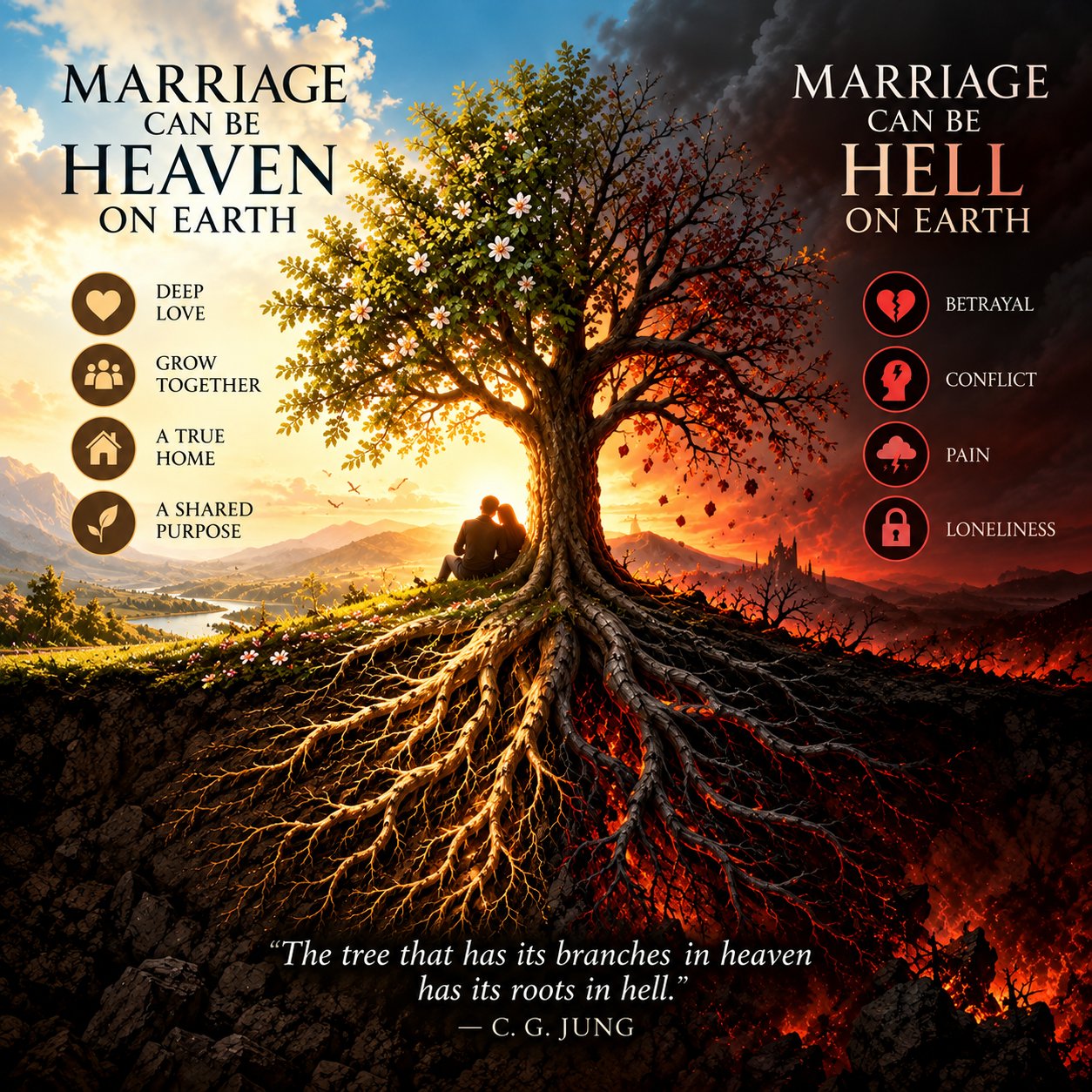
Marriage is one of the most powerful forces a human being will ever experience, and that power cuts both ways. It can be the closest thing to heaven on earth: two people who know each other completely and are loved anyway. The same marriage, gone wrong, can become the most miserable hell on earth, because you live beside the person who can wound you most deeply.
That is why the apostle Paul, after writing about husbands and wives becoming "one flesh," stopped and said, "This is a great mystery" (Ephesians 5:32). "One flesh" is closer to a graft than a poem: two branches bound until the living tissue grows together. Pull them apart years later and you do not get two clean branches back. You get two wounds.
Through its love, marriage produces life: children, a home, a legacy. Through its breaking, it produces suffering that reaches just as far. Carl Jung put it in a single image: "No tree, it is said, can grow to heaven unless its roots reach down to hell."¹
This is also why marriage has always mattered far beyond the couple. Aristotle saw households as the building blocks of villages and cities; Cicero called marriage "the first bond of society." Marriages are the bricks in a community's wall. Pull out enough of them, and the wall comes down.
A Promise, Not a Feeling
Wedding vows promise a love no one can command. The Lutheran pastor Dietrich Bonhoeffer, writing a wedding sermon from a Nazi prison cell, explained how that is possible: "It is not your love that sustains the marriage, but from now on, the marriage that sustains your love."²
You Do Not Know What Happens Behind the Door
A house can look beautiful from the street while termites have been eating the beams for a decade. Marriages are the same. The church pew and the holiday photos can hide neglect, contempt, abandonment or worse. Psychologist John Gottman, who has studied thousands of couples, found that the strongest predictor of divorce is not arguing but contempt, the steady message that "you are beneath me."³
The writer Rod Dreher, a traditionalist who has spent his career defending marriage, fought for his own for about a decade before his wife filed for divorce in 2022. What changed most afterward, he has written, was not his theology but his readiness to judge others. His marriage had looked normal in public while both of them suffered in private.⁴ So before we pronounce a verdict on anyone's divorce, we should ask: Do I actually know what happened? Usually we do not.
Do Christians Divorce Less? What the Research Says
You may have heard that "Christians divorce at the same rate as everyone else." A 2008 Barna study found 32 percent of born-again Christians had been divorced, versus 33 percent of other adults.⁵ But Barna measured belief, not practice. When researchers look at how people actually live, the picture changes:
- Christians who rarely attend church have divorced at about 60 percent; regular attenders, about 38 percent (sociologist Bradley Wright).⁶
- A Harvard study of more than 66,000 married women found that those attending services more than once a week had about a 50 percent lower risk of divorce.⁷
- Couples who pray together report significantly higher relationship happiness than those who don't.⁸
It is not a label that protects a marriage. It is a life: worship, prayer and a community that knows you.
What Does the Bible Say About Divorce?
Many assume the Bible offers one simple rule: divorce is always wrong. The texts are more careful, and more merciful.
- God hates treacherous divorce. Malachi 2:16 condemns the man who discards the wife of his youth.
- God Himself is described as divorced. Israel was His "wife," and after her repeated unfaithfulness He says, "I sent her away with a decree of divorce" (Jeremiah 3:8). If divorce were always sin, God would be guilty of it.
- Jesus raised the standard and named an exception. Against men who divorced "for any cause," He pointed back to creation, yet added: "except for sexual immorality" (Matthew 19:9).
- Paul freed the abandoned. "If the unbelieving partner separates, let it be so. In such cases the brother or sister is not enslaved" (1 Corinthians 7:15).
Sincere Christians have put these texts together in four main ways: no divorce and no remarriage; divorce but no remarriage; divorce and remarriage for adultery or desertion (the historic Lutheran and Reformed view and most evangelicals); and divorce and remarriage in a wider range of circumstances (the Orthodox practice and many mainline churches). These are serious positions held by serious people. So can a divorced Christian remarry? Your answer will depend on which of these views your church holds, which is exactly why that question should be worked through with your pastor, not alone.
Is Divorce a Sin? Where I Stand
Divorce is not always a sin. The one who is betrayed, deserted or endangered does not sin by acknowledging that the covenant has already been broken. A man who jumps out of a burning house has not abandoned his home. The fire did that.
But divorce is sin when it is the fruit of sin: leaving to pursue adultery, or walking away for shallow reasons like "I just don't love him anymore."
"But Jesus said whoever marries a divorced woman commits adultery!" He did (Luke 16:18). But Matthew records the same teaching twice, both times with Jesus' own exception (5:32; 19:9). A highway sign that says "Speed Limit 65" doesn't add "except for ambulances." Everyone understands it. Mark and Luke give us the sign; Matthew shows us the ambulance.
"Paul said a wife is bound as long as her husband lives." In Romans 7:2–3 Paul is using marriage as an illustration of the law, not teaching on divorce. You cannot build a house on a metaphor.
It Is Not Just "You and Jesus"
One of the most dangerous ideas in modern Christianity is that divorce is a private matter: "It's between me and God. I prayed about it, and I have peace." That sounds spiritual, but it is a lie from hell. A hand that decides it only needs the brain, not the arm, does not become free. It becomes severed.
Scripture calls us to submit to those who "keep watch over your souls" (Hebrews 13:17) and to bring broken relationships before others (Matthew 18:15–17). Vows made in public should not be ended in private. Submit your situation to your pastor and elders, tell the whole truth, and be willing to hear "not yet." And church leaders: listen before you judge.
For Those Who Are Grieving
A divorce is a death without a funeral. No casseroles, no sympathy cards, no graveside. Grieve it anyway. Refuse bitterness, which is like drinking poison and waiting for the other person to die. Tell your children, often, that it was not their fault. And don't give up on love. One failed marriage does not prove that marriage is a lie. It proves we live in a broken world, and that love requires two willing hearts.
Marriage is sacred. Divorce is tragic. And people are more complicated than the verdicts we are so quick to hand them.
You Need Someone Who Has Been Through It
Please don't go through this alone. You need someone who knows not only how the pit of divorce feels, but how to climb out of it. I had that person in my pastor. If you don't have one, I would be honored to walk with you.
Schedule a private, confidential conversation with me
Want to Go Deeper? Get the Free Booklet
This article is only the beginning. My free 60-page booklet, When a Marriage Dies: A Sober Word About Divorce, Remarriage and the Children Caught in Between, goes much further:
- The four Christian views, and which churches hold each one
- The five voices who shaped the Church's answer, from Augustine to John Paul II
- Answers to the six hardest biblical objections
- Remarriage, blended families and starting again
- How to help your children through divorce at every age
- A reading list from Catholic, Orthodox, Lutheran, Anglican and evangelical traditions, with 39 cited sources
Subscribe free and get the booklet
Next: Children and Divorce: What It Does to Them and How to Help Them at Every Age
Related reading: 4 Unexpected Ways to Address Marriage Problems
Notes
1. Carl Jung, Aion, Collected Works vol. 9ii, para. 78.
2. Dietrich Bonhoeffer, "A Wedding Sermon from a Prison Cell" (1943), in Letters and Papers from Prison.
3. The Gottman Institute, "The Four Horsemen: Contempt".
4. Rod Dreher's Diary.
5. Barna Group, "New Marriage and Divorce Statistics Released" (2008).
6. Bradley R.E. Wright, Christians Are Hate-Filled Hypocrites… and Other Lies You've Been Told (2010); see The Gospel Coalition.
7. Li, Kubzansky and VanderWeele, PLOS One (2018).
8. Institute for Family Studies, "Better Together".
Scripture quotations are from the English Standard Version (ESV).